
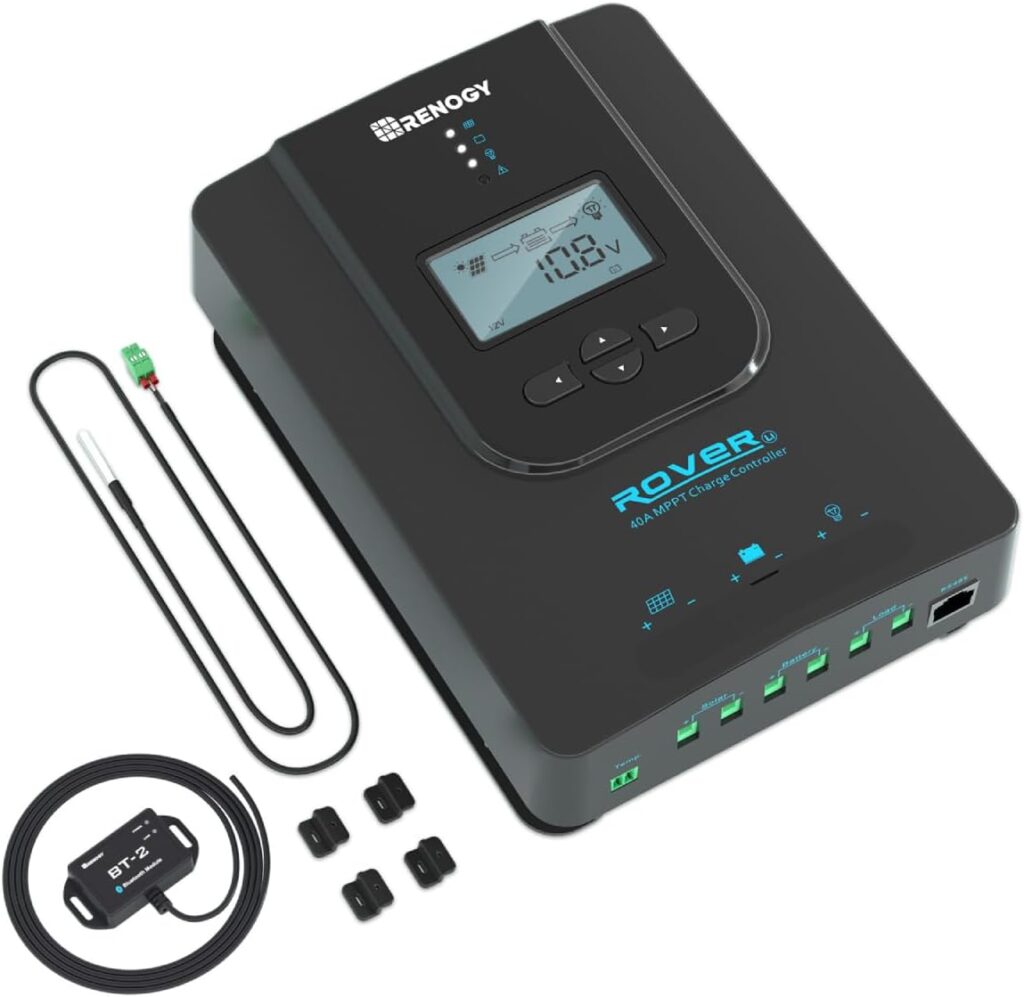
Renogy Solar Charge Controller
| Color | Black |
| Brand | Renogy |
| Voltage | 24 Volts (DC) |
| Product Dimensions | 2.85″L x 6.81″W x 9.37″H |
| Material | Plastic |
About
Renogy Solar Charge Controller
A Renogy Solar Charge Controller is a vital component for any solar setup — from small off-grid systems to larger home or RV installations. It regulates the power generated by solar panels before directing it to batteries, ensuring safe, efficient, and long-lasting energy storage.
Why You Need a Solar Charge Controller
Prevents overcharging of batteries — overcharging can reduce battery lifespan or cause damage.
Provides over-voltage, over-discharge, and short-circuit protection, ensuring both battery and connected devices stay safe.
Matches solar panel output to battery capacity, maximizing solar energy harvesting while preserving battery health.
Enables battery type compatibility (e.g., lead-acid, AGM, gel, LiFePO₄), giving flexibility based on your storage needs.
Features Typically Found in Renogy Controllers
MPPT (Maximum Power Point Tracking) for higher solar efficiency — extracts maximal power from panels even under varying sunlight conditions.
LCD or LED display panel which shows real-time data: input voltage, output current, battery status — useful for monitoring system health.
Adjustable settings for load control, charging modes, battery type, and safety thresholds to match your system and needs.
Durable, weather-resistant housing — many Renogy controllers suit outdoor or semi-outdoor installation, ideal for solar sheds, RVs, or outdoor battery banks.
Ideal Use Cases
RVs and campers — regulates solar charge for onboard battery systems.
Off-grid cabins or cottages — powers lighting, small appliances, and battery storage.
Garden, gate, or electric fence systems — provides stable charge for battery-backed equipment.
Backup power and solar kits — integrates with portable solar panels or home solar kits for energy storage.
Tips for Best Performance
Choose the right controller size for your panel output and battery capacity — undersized controllers can limit charge, oversized ones may be inefficient.
Regularly monitor battery voltage and load status to avoid over-discharge.
For outdoor installations, ensure controller is mounted in a shaded or ventilated location to prevent overheating.