
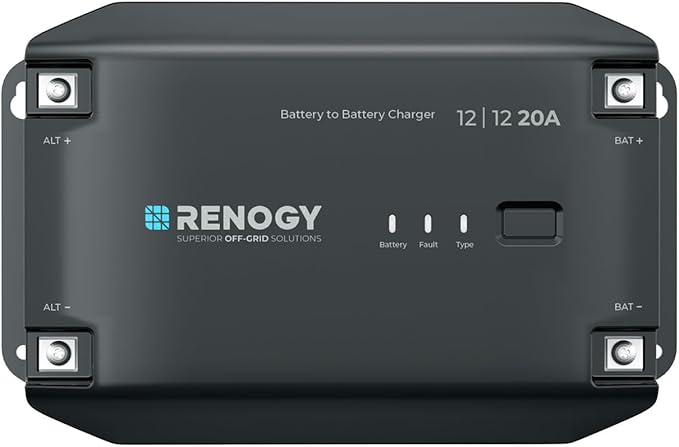
Renogy DC to DC Charger 12V 20A - Multi-Stage Charger for LiFePO4
| Brand | Renogy |
| Product Dimensions | 2.3″D x 9.31″W x 5.17″H |
| Item Weight | 3.3 Pounds |
| Output Voltage | 12 Volts (DC) |
| Input Voltage | 16 Volts |
About
Renogy 12V 20A DC‑to‑DC Charger
The Renogy 12 V 20 A DC‑to‑DC Charger is designed for dual‑battery systems such as in RVs, camper vans, boats, or off-grid vehicles. It safely charges an auxiliary (house) battery using power from the vehicle’s main (starter) battery and alternator while driving. This ensures your battery bank stays charged and ready without needing external mains power.
✅ Main Benefits & Features
Multi‑Chemistry Compatibility: Supports lead‑acid (AGM, gel, flooded) and lithium‑iron phosphate (LiFePO4) batteries — giving flexibility to choose the battery type that fits your setup.
Multi‑Stage Charging: Uses a smart multi‑stage charging algorithm (bulk, absorption, float, equalization for supported batteries) that ensures efficient and safe charging, prolonging battery life.
Automatic Alternator Input Handling: The charger detects when the engine is running (or alternator output is present) and only charges the auxiliary battery under those conditions — preventing drain on the main battery.
Compact & Durable Design: With corrosion‑resistant housing, wide operating temperature range (‑25 °C to 60 °C), and robust build, it’s suitable for vehicles, boats, and outdoor environments.
Low Idle Consumption: When not actively charging, the charger draws minimal standby current, reducing unnecessary drain on battery — helpful for long-term installations.
🔌 Typical Use Cases
This charger is ideal for:
RVs, camper vans, or caravans needing reliable “house battery” charge while driving
Boats or marine setups where battery banks power lights, fridge, and accessories
Off‑grid vehicles or mobile work vans carrying LiFePO4 or lead‑acid deep‑cycle batteries
Backup power systems where auxiliary batteries are used for appliances and need controlled charging
⚠️ What to Watch Out For / Installation Tips
Must wire properly: input from alternator/main battery → charger → output to house battery; include proper fuses close to battery for safety.
For best performance, install the charger close to auxiliary battery and ensure adequate ventilation to avoid overheating.
While compatible with LiFePO4, check your battery’s recommended charging current; a 20 A charger may be too much for small‑capacity batteries.
If your vehicle uses a “smart alternator” (modern cars), ensure charger settings match — some smart alternators output unstable or lower voltages, but Renogy’s charger handles wide input range.