
About this item
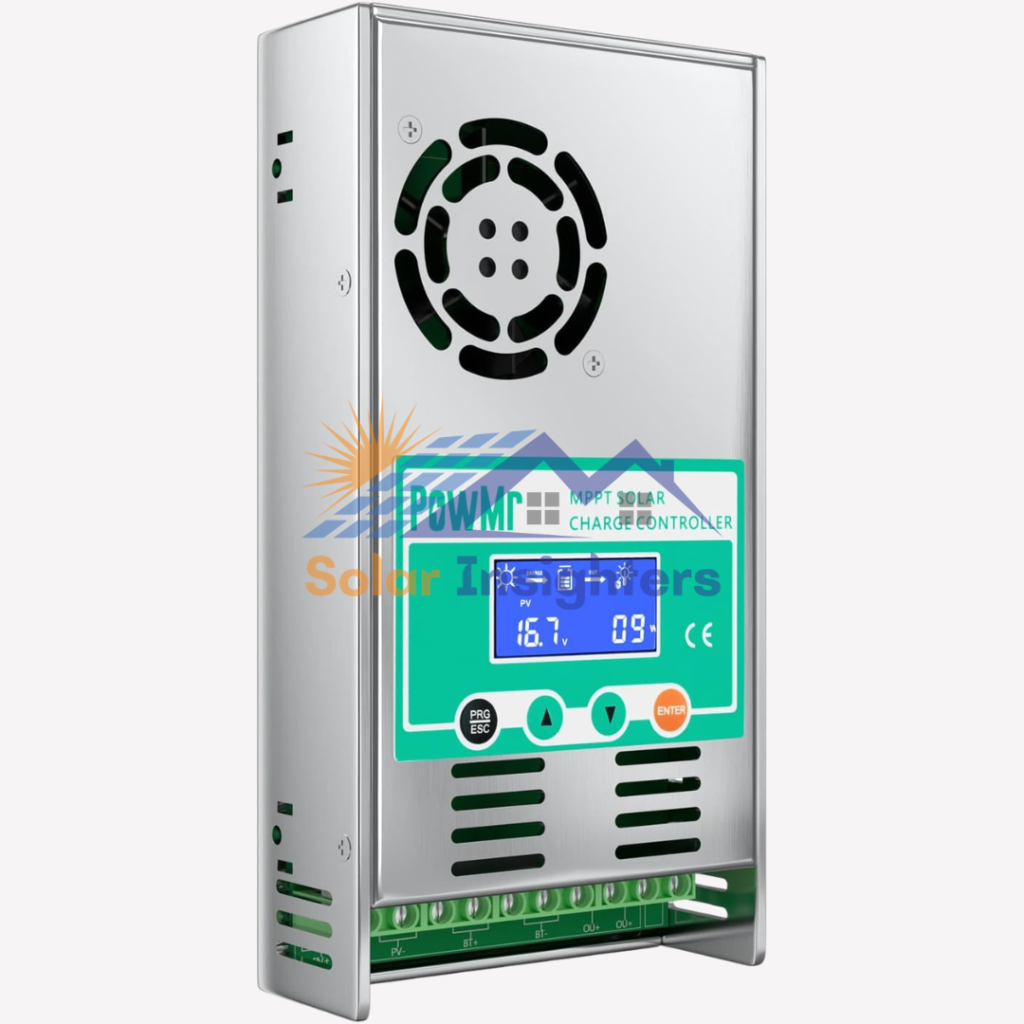
PowMr MPPT 60 Amp Solar Auto Charge Controller
The PowMr MPPT 60 Amp Solar Auto Charge Controller is a high‑performance device used in solar power systems to optimize solar energy harvest, charge batteries efficiently, and protect the entire system. Designed for medium to large off‑grid solar installations, this controller uses MPPT (Maximum Power Point Tracking) technology to extract the maximum possible power from solar panels — significantly improving charging efficiency compared with older PWM controllers.
With a 60 amp output, it’s suitable for solar arrays of moderate size, especially when charging 12 V, 24 V, 36 V, or 48 V battery banks.
Key Features
🌞 MPPT (Maximum Power Point Tracking) Technology
- MPPT constantly finds the best operating voltage for your solar panels to get the highest power output.
- This can improve energy harvest by 10–30 % compared to PWM controllers.
🔋 60 Amp Charging Capacity
- Supports up to 60 A of charge current — ideal for medium to large solar setups.
- Works with battery banks up to 48 V.
🔄 Automatic Voltage Recognition
- Automatically detects 12 V, 24 V, 36 V, or 48 V battery systems — no manual wiring switches.
📊 LCD Display & Smart Interface
- Built‑in LCD screen shows real‑time data:
- Charging voltage/current
- Battery level
- Solar panel output
- System status
- Error codes
🔐 Comprehensive Protection Features
The controller protects against:
- Overcharging
- Over‑discharging
- Reverse polarity
- Short circuits
- Overcurrent
- Overheating
🌡 Temperature Compensation
Automatically adjusts charging parameters based on ambient temperature to protect battery health in hot or cold conditions.
🛠 Easy Installation
Standard auto‑recognition and well‑labelled terminals make setup simple — even for DIY solar systems.
📱 Optional Bluetooth Monitoring (Some Models)**
Certain versions support Bluetooth via app for real‑time monitoring on smartphones.
How It Works
- Solar panels produce DC power.
- The MPPT controller continuously adjusts the panel load to maximize power input.
- More solar power is safely delivered to the battery bank, improving efficiency.
- The controller regulates charge voltage/current to prevent overcharging and prolong battery life.
Pros and Cons
| Pros (Advantages) | Cons (Disadvantages) |
|---|---|
| Highly efficient MPPT technology | More expensive than PWM controllers |
| Supports 12‑48 V automatic systems | Can be complex to configure for beginners |
| Large 60 A current capacity | Requires proper heat dissipation |
| Better energy harvest than traditional controllers | Requires compatible battery setup |
| LCD display with real‑time info | Bluetooth feature may cost extra |
| Comprehensive protection features | Installation must be correct to avoid faults |
Best Uses
The PowMr MPPT 60 Amp Solar Auto Charge Controller is ideal for:
- Medium/large off‑grid solar systems
- Home energy storage systems
- Cabin or vacation home solar setups
- RV and caravan solar installations
- Solar‑powered pumps and equipment
- Battery banks (LiFePO4, lead‑acid, AGM, gel)
It’s designed for systems where solar array sizes demand robust charging capacity and intelligent tracking.
Installation Tips
✔ Mount the controller in a cool, ventilated area to avoid overheating.
✔ Always wire solar panel → controller → battery in sequence.
✔ Use appropriately sized fuses and cables for safety and performance.
✔ Confirm battery voltage before connecting to avoid confusion.
✔ Keep the LCD screen accessible for system monitoring.
Why MPPT Matters
MPPT controllers like this one optimize power extraction by matching solar panel voltage to battery requirements. When panel voltage is higher than battery voltage (common in most solar arrays), MPPT squeezes extra power that PWM controllers simply cannot harvest — especially under cloudy or variable light conditions.
This results in faster battery charging, better overall efficiency, and more usable solar energy.