
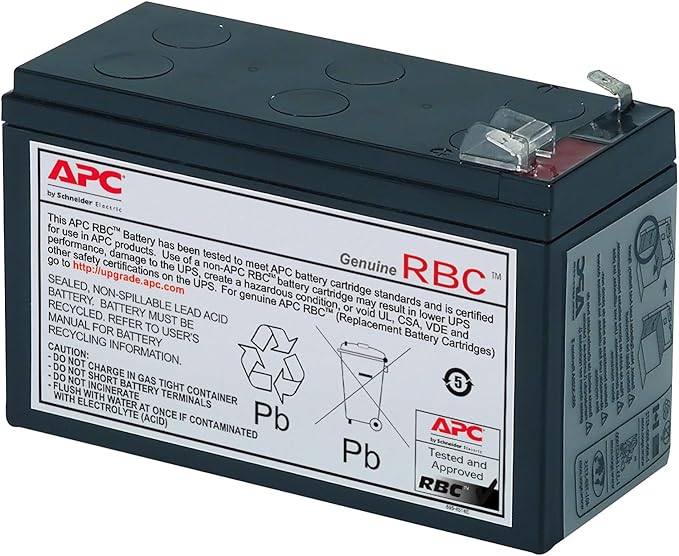

About this item
APC UPS Replacement Battery
An APC UPS Replacement Battery is a critical component for maintaining uninterrupted power supply (UPS) systems that protect your devices from power outages, surges, and fluctuations. APC (American Power Conversion) is a trusted brand known for high‑quality UPS systems and batteries that ensure reliable backup power for computers, home networking equipment, office electronics, and critical systems.
Replacing an old UPS battery when its performance degrades is essential for maintaining proper backup run‑time and system health. This review explores key features, compatibility, performance, installation tips, pros, and cons of APC UPS replacement batteries.
Key Specifications (Typical)
| Feature | Typical Details |
|---|---|
| Brand | APC (Schneider Electric) |
| Battery Type | Sealed Lead Acid (SLA) / VRLA |
| Voltage | Common: 12 V per battery |
| Capacity | Varies (Ah rating depends on model) |
| Use | UPS backup power replacement |
| Compatibility | APC UPS models (specific fit based on part number) |
| Rechargeable | Yes |
| Maintenance | Maintenance‑free design |
| Lifespan | Typically 3–5 years (usage dependent) |
Actual specifications depend on the exact APC battery model you choose. Always check compatibility with your UPS model.
Compatibility & Fit
APC UPS replacement batteries are designed to fit specific APC UPS models. Each battery has a part number that must match or be compatible with the corresponding UPS unit. Popular series such as APC Back‑UPS, Smart‑UPS, and others use different battery modules, so verifying the model number before purchase is crucial.
Common factors to check:
UPS model number and battery part number
Voltage and amp‑hour (Ah) rating
Number of battery modules required for your UPS
Using a compatible replacement ensures proper performance, safety, and warranty support for your UPS.
Performance & Backup Power
APC replacement batteries are engineered to deliver reliable backup power when the main power source fails. Typical benefits include:
Provides clean, uninterrupted supply to connected devices
Supports safe shutdown procedures during extended outages
Protects sensitive electronics from data loss
Helps maintain network equipment uptime
Battery capacity (Ah rating) and UPS configuration determine how long your equipment can run during a power cut. Higher Ah ratings generally provide longer run times for the same load.
As batteries age, they hold less charge — reducing backup duration. Replacing old batteries restores peak runtime and reliability.
Installation & Safety Tips
Installing an APC UPS replacement battery is generally straightforward, but should be done with safety in mind:
Power down and unplug the UPS from mains.
Turn off and disconnect all connected equipment.
Open the UPS battery compartment (follow the user manual).
Remove the old battery carefully.
Insert the replacement battery matching the part number and orientation.
Reconnect cables and secure the compartment.
Plug in the UPS and perform a test to verify proper operation.
Always wear protective gear when handling batteries, and avoid shorting battery terminals. Follow manufacturer instructions and recycle old batteries properly.
Durability & Lifespan
APC UPS replacement batteries typically last between 3–5 years, depending on use, temperature, and charging cycles. Higher ambient temperatures or heavy discharge cycles can shorten battery life, while cool, stable environments help extend it.
Regular testing and periodic replacement help maintain UPS reliability, especially in environments where power stability is critical.
Pros & Cons
| Pros | Cons |
|---|---|
| Designed specifically for APC UPS systems | Limited to compatible models |
| Reliable backup power | Batteries wear out over time |
| Maintenance‑free sealed design | Requires periodic replacement |
| Easy installation | Must match correct part number |
| Protects electronics from outages | Initial cost adds to UPS maintenance |
| Restores full runtime to UPS | Disposal and recycling required |