
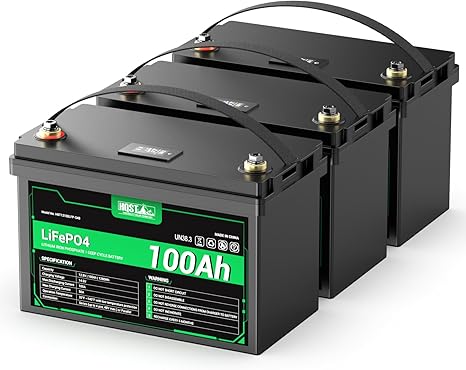
HQST 12 Volt 100Ah Lithium Iron Phosphate Battery
| Brand | HQST |
| Vehicle Service Type | Boat, Personal Watercraft, RV, Van |
| Size | 3 Pack with LED Meter |
| Voltage | 12.8 Volts |
| Battery Cell Composition | Lithium Polymer |
| Item Weight | 22 Pounds |
| Automotive Fit Type | Vehicle Specific Fit |
| Manufacturer | HQST HIGH QUALITY SOLAR TECHNOLOGY |
About this item
HQST 12 Volt 100Ah Lithium Iron Phosphate Battery
The HQST 12 Volt 100Ah Lithium Iron Phosphate (LiFePO₄) Battery is a high-performance, deep-cycle battery designed for a wide range of applications including solar energy storage, RV power systems, marine use, off-grid setups, and backup power. LiFePO₄ chemistry is known for excellent cycle life, thermal stability, and safety, making it one of the most reliable lithium battery types available.
This review will help you understand the performance, features, real-world use cases, installation tips, safety, pros, and cons of this 12 V 100Ah battery.
Key Specifications
| Feature | Details |
|---|---|
| Brand | HQST |
| Voltage | 12 Volt |
| Capacity | 100 Ah (1.28 kWh nominal) |
| Battery Type | Lithium Iron Phosphate (LiFePO₄) |
| Chemistry | LiFePO₄ |
| Nominal Energy | ~1280 Wh |
| Cycle Life | 2000–5000+ cycles (typical) |
| Weight | Lighter than equivalent lead-acid |
| Warranty | Varies by seller/market |
Always confirm exact specifications with seller or official documentation for your region.
Design & Build Quality
The HQST 12 V 100Ah battery is built with a robust housing that protects internal cells and circuitry. LiFePO₄ chemistry enhances safety with excellent thermal and chemical stability, reducing the risk of overheating compared to other lithium types.
The battery is typically designed for easy installation in battery boxes, solar systems, RV battery banks, or backup setups. Its compact size and lighter weight make it easier to handle and install than traditional flooded or AGM lead-acid batteries of similar capacity.
Performance & Energy Output
With a 12 V and 100 Ah rating, this battery stores around 1.28 kWh of usable energy, delivering smooth, reliable DC power for a variety of devices and systems:
Solar charge controllers and inverters
LED lighting and appliances
RV electronics and appliances
Marine electronics and trolling motors
Backup power for modems, routers, alarms
Unlike lead-acid batteries, LiFePO₄ cells maintain stable output voltage under load and recover quickly after discharge, helping devices run more efficiently.
Cycle Life & Longevity
One of the major advantages of LiFePO₄ chemistry is its long cycle life. The HQST battery typically delivers 2000–5000+ charge/discharge cycles — significantly more than lead-acid counterparts. This means longer service life and lower cost per cycle over time.
Deep-cycle capability also allows frequent discharges without damaging the battery, making it ideal for daily solar cycling or regular off-grid use.
Safety & Thermal Stability
Lithium Iron Phosphate batteries are known for superior safety performance:
High thermal stability
Minimal risk of thermal runaway
Built-in battery management systems (BMS) protect against overcharge, over-discharge, and short circuit
More stable under extreme temperatures compared to other lithium chemistries
These safety characteristics make the HQST battery suitable for residential, mobile, and outdoor applications.
Compatibility & Use Cases
This 12 V 100Ah LiFePO₄ battery works well in many systems:
Solar Energy Storage
Pairs with 12 V charge controllers and inverters to store solar generation for use at night or during outages.
RV & Camper Power
Ideal for powering appliances, lighting, and electronics on the road due to its lightweight and deep-cycle nature.
Marine & Outdoor Use
Long cycle life and safe chemistry make it suitable for boats, fishing trips, and outdoor gear.
Backup & Emergency Power
Reliable power for routers, alarms, LED lights, and small appliances during grid outages.
Before purchase, confirm your system’s voltage compatibility and BMS requirements, especially when integrating with inverters or solar chargers.
Installation & Maintenance
Installing the battery is straightforward:
Place in a dry, ventilated location
Connect terminals with proper gauge cables
Ensure correct polarity (positive to positive, negative to negative)
Pair with solar charge controller/inverter settings appropriate for LiFePO₄ chemistry
LiFePO₄ batteries are maintenance-free, unlike flooded lead-acid models that require water topping and regular checks.
Pros & Cons
| Pros | Cons |
|---|---|
| Long cycle life (2000–5000+) | Higher upfront cost vs lead-acid |
| Lightweight and compact | Requires compatible charger/inverter settings |
| Safe LiFePO₄ chemistry | Must verify exact model specs |
| Fast charging and efficiency | Not ideal for very small loads alone |
| Stable output under load | Specialized recycling required |
| Maintenance-free | Not always stocked everywhere |